Director David l Hewitt (1939-) is certainly a low budget name which should be cherished. His movies are largely forgotten now and it’s a shame he doesn’t do more interviews to discuss his achievements. The best of these are his time themed movies which include rather ingenious plot points or twists. These include the slightly goofy and comical The Time Travellers (1964), which Hewitt co-wrote and his follow-up entitled The Wizard of Mars (1965) which is associated with the name of another low-budget icon Tom Graeff (1929-70 suicide) of Teenagers from Outer Space fame (1959) who did the editing. The final of the three is Journey to the Center of Time (1967) which has the similar paradox of a time warp and being lost in time. It is The Wizard of Mars which sticks in my mind the most with its grandiose ending shot on the smallest of budgets. Hewitt was a stage magician in a travelling ‘spook’ show who started writing in that medium before he collaborated on The Time Travellers. It is reported that Famous Monsters of Filmland founder Forest J Ackerman (1916-2007 heart failure) gave Hewitt a script for The Time Travellers to rewrite and the results were this movie which starred John Hoyt (1905-01 lung cancer), Preston Foster (1990-70 cancer) and Steve Franken (1932-2012 cancer) among others.


How much of the time travel paradox in The Time Travellers is the idea of Hewitt’s remains uncertain but it is one of several movies in the 1960s to deal with the issue whereas most movies in the 1950s were less cerebral in their approach towards aliens and monsters with their men in suits. Directed by Ib Melchior (1917-2015 no info), Time Travellers was known under the title Time Trap and Melchior had worked on sci-fi movies The Angry Red Planet (1959) as well as co-writing Robinson Crusoe on Mars (1964).
The Time Travellers is where the cast has “discovered the end of the world” with a portal into the future which in this case is 2053 where it is found “sound won’t pass through the time portal”. It is then discovered that a frame in the time lab can be walked through to investigate a future or past world. We come across some primitive beings who were reportedly played by the Los Angeles Lakers and resemble somewhat the natives in the British movie The Terrornauts (1967). An unfortunate blonde lab assistant leaves her post just as a “blowout” occurs possibly leaving them stranded through the portal.
Preston Foster runs through the hills and appears to lose his toupee in one scene along a desert trail while there is the appearance of Charlie Chan movie regular Joan Woodbury (1915-89 no cause) as Gadra, Leader of the Androids. Otherwise there’s John Hoyt dressed in a Las Vegas Elvis costume while mentioning Foster again – he sports a monocle.


The film itself is possibly unexceptional although the colour stock is fully saturated and it is lensed very capably by Vilmos Szigmond (1932-2016 natural causes). Filmed in Barstow, California actor Steve Franken stands out in a rather silly role. It is reported that the film was financed by a bunch of vending machine operators whom Hewitt convinced sci-fi movies would make a good investment. Thus American General Pictures was formed.
The tour de force is the ending where the crew step through a portal from the future to the present day only to find themselves frozen in time in the past by several minutes… “Somehow we’ve disrupted the time flow!” As they “seem to be existing at a different time rate… a 1000th faster than normal,” says Hoyt. It is then that the scientists are chased through a portal again into what looks like the promised land after what has been a rather apocalyptic movie…. It is meanwhile that their frozen doubles come back to life and enter the portal 1000s of years into the future only to experience altered time travel as they also experience the same adventure again and again until the end of time we gather which is either never or until they simply disintegrate or disappear. For these travellers on the other hand there is no promised land. The montage is extremely clever and so is the end of the movie. If one wants to marvel at the possibilities of time travel it is with this movie.
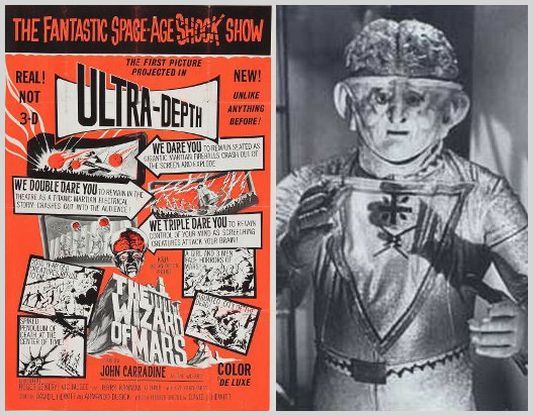
Now for the Wizard of Mars and its astronauts who pass by the titular planet where they become lost and oxygen depleted only to chance upon a golden road which leads to a ruined city. The cue is obviously taken from The Wizard of Oz (1939) although it is hardly as camp despite the cheap trappings. In fact, it is probably Hewitt’s masterpiece.
To pick up somewhat later in the movie and there is a mysterious red dome which surrounds the city somewhere in the deserts of Mars.
“Do you suppose it could be inhabited?,” asks the female of the bunch and as they enter we find that electronic music haunts the hallways in what must have been a pretty snazzy joint back in the day. They also discover what look like mummified aliens
“Whatever it is, I’m glad it’s dead.” But is it? These creatures with giant brains or large cranial capacity glow red and communicate – “Share my mind!”


For the budget, this is a bravura sequence with creatures which have a slightly disturbing look along with optical and sound effects which are brought together extremely successfully. Then there’s John Carradine’s (1906-88 multiple organ failure) monologue which has opticals reminiscent of his later Frankenstein Island (1981) by Jerry Warren (1925-88 lung cancer) where Carradine’s Martian speaks from “a dimension of time of our own creation”. These “monsters” from space found the end of their evolution and had them “impale(d) time on an axis” as it became a part of their own universe. But contrary to the laws of the universe the least mystery of the universe was that life could not exist without death. They stopped time these aliens… and it is up to the astronauts to start it again and inside the essential snow cone of a crystal ball is a “city plucked from time”… Then there’s a pendulum where the ball must be placed and this pendulum starts with alien voices.
“Do not gaze upon time too long,” says Carradine as the city collapses and then it was as a dream as the city collapses and the astronauts are transported back to their ship. And so it is mentioned that only in the span of man’s evolution has time been measured by the planets. And “time has a quality as hazy and as distant as the perimeter of our own galaxy” and “the haze clears for some minds and man may find some solution between the past and the future.”
The Wizard of Mars isn’t a great movie but Hewitt has created something which speaks the philosophy of time with the only paradox being death of the inability to die. It’s something which rings true in terms of the monologue as well as the misty narration. We believe in the city and the concept of time perhaps not as profoundly as in The Time Travellers but this film is a forerunner to the high concept big budget movies which would come with the new millennium whereas Journey to the Centre of Time would also be of this ilk but on a far more Saturday matinee level. But beware Hewitt’s movies are cheap and while he fools us some of the time he doesn’t fool us all of the time, something he toys with us in The Mighty Gorga.
Carradine did one day’s shoot for Wizard of Mars and Al Adamson (1929-95 murdered) used footage for the film in Horror of the Blood Monsters (1970). Cast members included Roger Gentry (1934-2013 undisclosed) from Hewitt’s Gallery of Horror (1967), Vic McGee (no info) who wrote for tv show Welcome Back Kotter, Jerry Raddow (1934-) and former Las Vegas showgirl Eve Bernhardt (1930-).


Journey to the Center of Time (1967) is a more complex offering and yet the most simple in terms of being a Saturday matinee movie. It stars cult favourite Anthony Eisley (1925-2003 heart failure) from such ‘classics’ as Navy vs the Night Monsters (1966) and Dracula vs Frankenstein (1971) and Scott Brady (1924-85 pulmonary fibrosis) from Destination Inner Space (1966) and Satan’s Sadist’s (1969) among many others. Other stars include Gigi Perreau (1941-) and Abraham Sofaer (1896-1988 congestive heart failure).
In this movie for which Hewitt wrote the screenplay (he also wrote Wizard of Mars from someone else’s story) we have a time travel research lab which is soon to be put out of business due to corporate greed. They are soon catapulted into the future where once more the world faces extinction. Along the way their time machine almost crashes into another time machine coming in the other direction at some point in the movie as they go back into the past which is the time of the dinosaurs. It is there that greed takes control once more when it is found that precious stones litter the caves of this past universe. It is then that Brady escapes with some booty only to find he is on a collision course with the time machine he encountered earlier. Sadly, as a part of the paradox, it would appear it is the time machine he has been travelling in earlier when he fired a rocket at it and he is destroyed by his own self. Eisley and Perreau travel back to the lab after having found the time machine and find they have returned a day before they have left. The scariest part of the movie is in fact the ending when the couple find themselves forever lost in time and space with possibly no hope of ever being retrieved.



The other films of note by Hewitt are his portmanteau low budget horror Gallery of Horror and his giant gorilla movie The Mighty Gorga (1967). It is hard to say which is worse as they both charm in different ways. Gallery of Horror features old-timers Lon Chaney Jr (1906-73 throat cancer) and Rochelle Hudson (1916-72 pneumonia) as it tells several unrelated horror tales linked by John Carradine’s narration. My favourite part has to be one of the most anachronistic scenes ever to appear in a motion picture as Jack the Ripper is brought back to life and lo and behold a modern day phone rings years before Alexander Graham Bell ever invented the thing. Gallery of Horror was once more written by Hewitt and it really has a hold on me to this day for its simplicity and unoriginal originality, or was that the other way round. Even the laughter and narration of the ghoulish character who comes back from the grave to kill his wife has a certain tongue in cheek quality. To the people who saw them first at the drive-in had no qualms as to what they were seeing on the screen and they probably didn’t want studio stuff anyway and were happy to settle for this sub-Corman trash. That isn’t to say Gallery of Horror hasn’t quality touches and some of the scenes are staged like theatre while others have a kind of silent movie touch to them.
Other movies I will mention are Hewitt’s short film Monsters Crash the Pajama Party (1965) which is an anarchic but too silly mess running about a half hour and his final movie which was The Lucifer Complex (1978) which upon serious viewing shows to be two movies pasted together and the results are poor. Hewitt may be responsible for the quality parts of the movie as there are two directors credited. By 1967, Hewitt was stretching his dollar and it showed after Journey to the Centre of Time…
The final classic has to be The Might Gorga. Anyone who has seen this movie will remember the inept ‘King Kong’ type gorilla and the native uttering the words “The Mighty Gorga!” By a rather portly native.
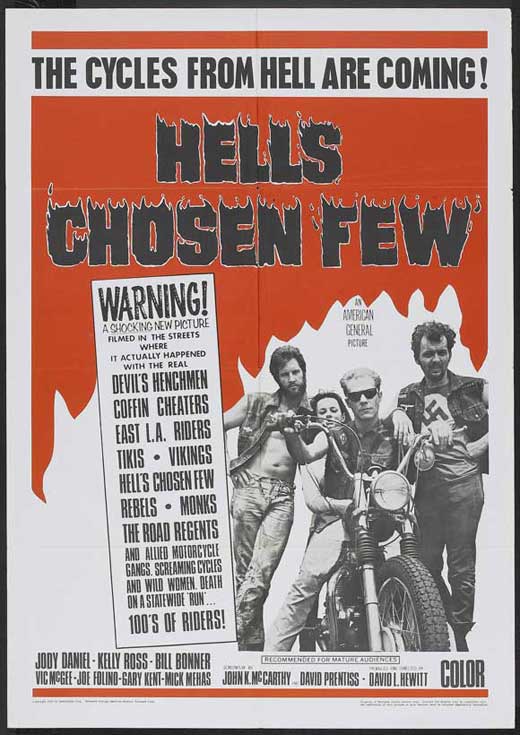
Anthony Eisley appears again and so does Kent Taylor (1907-87 heart surgery) and Scott Brady once more. The female in the lead is Megan Timothy (1943-) who appeared in Hewitt’s lesser known efforts Hell’s Chosen Few (1968) which looks like an improvised biker movie cashing in on the genre and The Girls from Thunder Strip (1970) which is another rather boring biker pic in a similar vein which has a dandy of an ending where a cougar mauls an errant biker in a mountaintop cave all depicted with a stuffed animal. The Tormentors (1971) also remains a Hewitt disappointment unless the biker genre is your type of thing. Perhaps his bikie films need reevaluation.


The African set The Mighty Gorga was shot in Bronson Canyon among other locations and is well known for its painted Californian number plate in Africa as well as using a fantasy sequence featuring a dragon which was lifted from Goliath and the Dragon (1960). The film also uses elements of King Solomon’s Mines with Bronson cavern decorated with what are obviously chests of plastic jewels and pearls. In between we have to our amazement The Mighty Gorga himself with buttons for eyes and something akin to being a child’s plastic doll sometimes playing dress- ups. That said, the whole film hangs together well, as all of Hewitt’s films do which goes to show he was no real slouch at directing. It’s just that like many of his other movies, it is defeated by its budgetary constraints. But isn’t that just the wonder of micro-budget movies and the producer/ writer/director Hewitt’s vision of what he had for them. It doesn’t matter if the script is good or bad … – IT LIVES! – like so many movies do. And just like Gorga at the end when Eisley says: “How do you thank a gorilla for saving your life?” Just like the poor souls at the end of Journey to the Centre of Time, these films are suspended in time forever a part of cult film anatomy or astrology or whatever you want to call it … and how do you thank a movie for saving your life?
 Cult Film Alley