There is some sort of parasite or invading insect which will enter a hive of bees for example and will infiltrate and will eventually destroy that hive. It isn’t necessarily anarchy at work since it is nature but the effect is just as devastating especially when it happens en masse. Nature is thrown out of balance and ultimately without hives of bees there is nothing to pollinate and the world will be barren and thus destroyed in terms of human beings being unable to feed themselves.
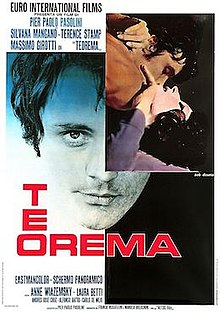
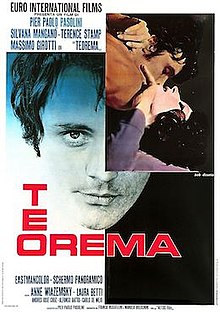
In comparison, vaguely perhaps, is actor Terence Stamp’s (1938-) slim and attractive young man, possibly with a perfetto penis, who invades the lives of a family in the movie Theorem (1967) which was directed by that feted homosexual director Pier Paolo Pasolini (1922-75 murdered).
Pasolini is probably best remembered for his sexualised romps Arabian Nights (1974) and The Canterbury Tales (1972). He is perhaps most renowned for his shit eating movie Salo, or the 120 Days of Sodom (1975) which topped off his career of excess by having itself banned in several countries. Pasolini had his head bashed in with a brick said one report while another said he was run over by his own car and his testicles smashed with a metal bar.


There was a remake of Theorem in Australia named Dallas Doll (1994) starring ‘bisexual’ actress and comedian Sandra Bernhardt (1955-). Further on this theme is the early talkie starring John Gilbert (1897-1936 heart attack) entitled Downstairs (1932) which was the best sound film the star made before his career ended due to alcoholism and tainted gossip about his transition to sound which was covered in such books as Moviola by Garson Kanin 1912-99 undisclosed). Gilbert played a new chauffeur on the staff of a rich family who ingratiates himself sexually with the staff and family. It’s good pre-Code stuff and his voice is obviously deep and passes the sound test which leaves one to wonder what all the fuss was about. His character is also a cad and not to be respected.


Then there is the Sheridan Whiteside character in The Man Who Came to Dinner (1942) who is played by Monty Woolley (1888-1963 kidney and heart ailments). Here we have a fast moving farce about a famous writer who comes to visit a family and slips and breaks a leg outside their front door. The family then have to put him up until he has healed appropriately. Sadly, for the family, Whiteside is not a sexual anarchist but a high society intellectual who dwarfs the personalities around him with outrageous demands and even more outrageous quips and pokes. Not quite door slamming farce the film is based on the play by Pulitzer Prize winner George S. Kaufman (1889-1961) and Moss Hart. (1904-61 heart attack) who wrote the screenplay for A Star is Born (1954) …… Here, sex and money have nothing to do with anything except in terms of the worries of the bourgeois family while the daughter finds happiness in the arms of another. The film belongs to well known homosexual Monty Woolley who made a number of films showing off his bigger than life personality as the wheelchair bound Whiteside.


Another sexual anarchist in a period when anarchy was rife in Russia and Europe under the reign of Tzar Nicolas (1868-1918 shot) was that character known as Rasputin (1869-1916 shot three times). Known for the wart on his large penis which gave pleasure to the clitoris’s of many women he also ingratiated himself into the family of the Tzar. This can be shown in the movie Nicolas and Alexandria (1971) which had the character played by Tom Baker who also appeared in Pasolini’s The Canterbury Tales (1972). It was the young son of the Tzar whom Rasputin would help to treat for his haemophilia and so he became indispensable in the household. The question is whether Rasputin was really a kamikaze anarchist or one who was only seeking sex and money is a question for historians. Or did he just wish to be a member of society?
In terms of the female of the species on the family level there is the example of Gene Tierney (1920-91 emphysema) as the mentally ill criminal who kills in Leave Her to Heaven (1945)… Is she an anarchist? Is the anarchist really a mentally ill loner in society? This film is in lush colour as it presents what is no doubt a bowdlerised version of the novel. Things like this aren’t done back in the day. It was quite a bold move to have Tierney murder a child on screen.


The core belief of the anarchist is their beef with the existing state of things in their environment and their wish to change them somehow no matter the cost. Then there is the incidental anarchist in Theorem, the sexual anarchist who only wants pleasure and who wants to give pleasure and understanding and freedom. He still wants a better world for those involved. This is the difference between the anarchist in the movie and the political assassins of such people as the one who killed the Archduke Ferdinand (1863-1914 shot) which became the trigger for World War One. Sex as opposed to violence. Sadly, in Theorem, the bourgeois cannot have sexual freedom due to the conventions which are laid upon them and the violent political anarchist knows the only option is death. Meanwhile the transient sexual anarchist moves from town to town having made his killing in terms of money and sex. Downstairs shows this while Theorem has a more Christlike Stamp.
Theorem is a tame example of Pasolini with no full frontal male nudity but the anarchist in terms of his entry into an Italian bourgeois family as a passing fling is perhaps Satan and not Christ in terms of Italian Catholicism. The film was incidentally filmed in the North. Certainly the blue eyes give it all away. This man is not from the area and we never really know where he comes from. He could be English or he could be from elsewhere. He rarely speaks and all we really know is that he is so liberating in bed for the family that it changes this nuclear family into profoundly changed individuals and through this brings on the family’s very destruction.
We have a father and mother and we have an idiot son and a doe-eyed daughter. Not to mention the black clad highly religious maid whose repressed sexuality defies lesbianism.


The film opens with the closing down of a factory possibly to make way for bourgeois redevelopment. Or was the factory given away to the workers to make way for a society without the bourgeois – a barren wasteland where the working class revolt? And this is perhaps a foreword or Pasolini’s premise in terms of the movie as the film itself is Pasolini’s mainstream incendiary for entry into that very international English language market. It was his first time with professional actors. The volcano perhaps Mount Etna is used to bookend the movie as some sort of crater where this bombshell has fallen. A nuclear family implosion!
After the seduction of the maid who is under some sort of impression that Stamp is the saviour although this is only hinted at with his Christlike eyes as he takes her incredibly tense self into his arms on her bed…. Then we cut to smoke over the volcanic ash once again for a moment as if there is another conquest of destructive nature from deep within.
Next is the son who is a repressed homosexual or who just wants to check out Terry’s cock as they sleep together in his bedroom. When it comes to sex all the son can do is look at coffee table books with erotic and kinky images and otherwise is unable to use his imagination. He is kaput.
We gather though that Terry and the son consummate their friendship as the father finds them asleep in bed together.


The mother then has a go with Terry and it is only the handsome straight father who does not have intercourse with this angel or devil or just another bisexual or pansexual human being. The father instead is stricken with some sort of palsy and Terry lays hands on him. Is the father a urinal peeper or the type that hangs out in public toilets? This is hinted at the end of the movie when he casts off the gown of his work clothes at a train station when possibly given a look by a younger man and eventually wanders naked through the crater of the volcano. The film is simple and surreal at times.
Is the father part of the businessmen who have shut down the factory? Is this to be retribution for putting so many working class people out of work? You just have to take a look at the man’s house to know he is mega rich. The old saying of the cup runneth over maybe the cup runneth out in terms of his family life and bourgeois greed and heresy in terms of breaking with conventional model sexuality and family role models. Then they must all sit down together like a family and eat like the families of yore and tradition while a choir sings Mozart opera or religion… And the daughter sets her bed sheets like a table cloth for another preparation to feast on Terry’s cock… or having already feasted. Or is it just for a confession? Once again religious music plays.


Having mentioned the ending, we have Terry depart about halfway through and for the son it is the life of attempting to be an artist – a piss artist in fact as he urinates on canvases and hangs them on the wall. The daughter in the meantime gets carried away on a stretcher catatonic while the maid comes across some sort of possibly religious commune in the Italian countryside where she meets a child with blue eyes or eyes similar to those of Terry and then becomes some sort of saint by the fact that she floats in the air! Or is it astral travel? Then there is no other choice but to be buried alive!!
As for the ending? Ashes to ashes, dust to dust… Another attempt at bourgeois respectability in terms of its facade is broken down as its members grow into positive and negative results of their religious upbringing and beyond … Possible ruin and death. Pasolini’s anarchist bomb is dropped into mainstream theatres and I mean it blows up certain sections of society, the church and boring families in genteel fashion. The film however is often viewed as a disappointment.
Interestingly, the Vatican criticised the film for its sexual content and an award from one Catholic organisation was withdrawn after this occurred.


As for the follow-up Dallas Doll (1994) which was filmed in Australia we have a misfire which is directed by a woman Ann Turner (1960-) and has a woman as the impish star who seduces a few members of a family in much the same way as Terry does in Theorem.
American Sandra Bernhardt (1955-) is best known for her role in the Robert de Niro movie The King of Comedy (1981) and for her expletive spattered stand-up comedy.
Here we have a family which once again are bourgeois and who own a large country property or stud farm. Along comes Dallas and seduces the borderline gay son who is so innocent he sleeps with a lamb at the beginning of the movie. Playing the sister in the movie in her screen debut is Rose Byrne (1979-) while Victoria Longley (1960-2010 breast cancer) is the mother who plays miniature golf indoors dressed in her undies with Bernhardt. The son is played by Jake Blundell (unknown).
The film starts off promisingly and the location shooting looks good but unfortunately it takes a wrong turn two thirds through when Bernhardt’s character unites the family and decides to become a small town entrepreneur and help the Japanese buy up the land underneath the family and have a casino built. The film was made at a time in Australia when xenophobia was rife over the buying up of Australian properties although the environment isn’t really considered above the town’s want to make a big buck. There is also wonder about a flying saucer as part of the film’s semi-whimsical tone as if the title character may have an alien connection.
I saw this film upon its first release at the Brisbane International Film Festival in 1994 and was mildly disappointed. Grabbed the VHS and it hadn’t’ improved. Now on Internet Archive and the whole production is too coy for words. A bit of titty and cock would have helped rather than a silly and rather pat ending.
Theorem and Dallas Doll are harmless today although the former has more to sink the teeth into in terms of film theory. The sexual anarchist who works in the boardrooms and rich bedrooms on the high end of town probably won’t get a movie made about them unless it is Demi Moore as the villain in Disclosure (1994). Even then we have moved from the family unit into the corporate family.
 Cult Film Alley