The 1970s Richard Burton (1925-1984 brain haemorrhage) movie The Medusa Touch (1978) is about telekinesis among other psychic abilities and it reminded me of an item on the news about a house fire somewhere in the suburbs which ended with the reporter saying: “and it is reported by police that the fire wasn’t started by telekinesis”. Obviously, someone was trying it on. Are you a believer or not? Is The Medusa Touch Nietzsche’s Will to Power taken to the extreme? Or is the ‘power’ something which can never be explained?
“I am awaiting the report,” says Burton in his chair at the beginning of the movie and we are uncertain whether he is talking to the person stalking him from behind or if he is picking up transmissions from the television before they are being broadcast.
How does clairvoyance happen? Is it something in the air? Is it something in our brains? Or is it both? Is the atmospheric soup full of souls who communicate these words to others or is it a load of poppycock sold by the devil? Is it the electricity in the air which also drives the heart which must be strong like that of Richard Burton, for he is about to be ‘murdered’ by his very own Napoleon statuette brandished by some unknown assailant.
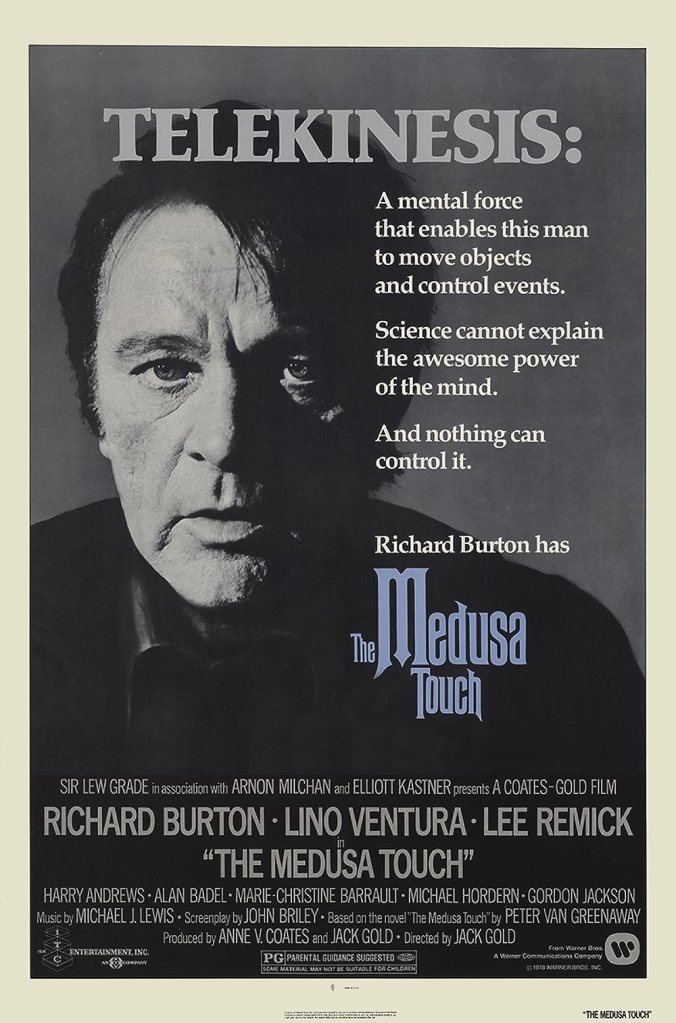


Director Jack Gold (1930-2015 unknown) was best known for his television work and The Medusa Touch is his most cultish film alongside Man Friday (1975) which starred Peter O’Toole (1932-2013 stomach cancer).
Burton is described as a “turnip (read: turn-up) for the books” as a pun by one cop who turns up at the bashing scene and Burton may have further psychic powers … shock, horror…Demonic personality that he has!
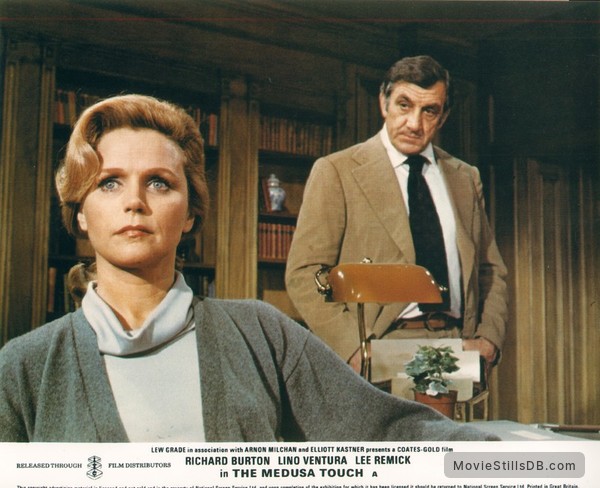
The cast includes Lee Remick (1935-91 kidney cancer), Lino Ventura (1919-1987 unknown) and Michael Byrne (1943-) from cult item Force 10 from Navarone (1978).
The mystery of The Medusa Touch is both the psychic elements and the reason why it isn’t considered more of a cult classic flawed that it is in terms of a mystery movie of both the criminal as well as the psychic.Who would want to murder Burton except for an angry barman or Elizabeth Taylor (1932-2011 congestive heart failure) after a late night barney a la Who’s Afraid of Virginia Woolf (1966).
“I have a gift for disaster,” says Burton in flashback as the police investigate his near death and what that gift is we are about to find out. Then further flashback to Burton as a boy: “It was wrath he poured his fury out, hell fire, tormenting the bad,” says his babysitter, reading the Bible or her local Satanic rag as a bedtime story. She died the very next week possibly thanks to Burton fixing his feverish gaze upon her. Not to mention his parents as they died too, rather tragically.


This is the beauty of the film. The almost comical presentation, which is not necessarily inept m movie making, of some of the characters’ deaths along with the narration by Burton which is both venal and Shakespearian and all delivered with cigarette and spirit soaked vocals.
Jack Gold and American screenwriter John Briley (1925-2019 unknown) – he won an Oscar for Gandhi (1982) – seem to be taking a tongue in cheek view at times whereas the investigative work being done by cop Ventura is deadly serious. I don’t think we see him laugh throughout the entire proceedings.
Then again it is no surprise that the original author of the 1973 novel The Medusa Touch was former lawyer Peter Van Greenaway (1927-1988 unknown) whose third work has been described as satirical as the film flashbacks again to a scene where Van Greenaway’s “misanthropic” prose is possibly quoted verbatim. Well, I guess it would have to be!
“I’m not surprised someone tried to kill him,” says Derek Jacobi (1938-) with a touch of camp is not one of the lines but it’s very delivery of the cliche which shows subtle satire. It is interesting that one article wrote that Van Greenaway does not exist in birth and death records and that little is known about him except what I have mentioned here which suggests his name is a pseudonym. An author of twenty of so works it was perhaps at the time chosen to add more mystery to The Medusa Touch’s themes. Somewhat now a bit passe in terms of their novelty.
In the victim’s apartment Edvard Munch’s The Scream takes pride of place along with other eclectic and esoteric artists’ drawn and painted works. And we know that Burton stares a lot at people and wishes them dead and then it happens. He is a typical bitter artist.


“She was a monster created to do battle with the Gods,” says Ventura about the piece on the wall which is that of Medusa herself by Caravaggio (1571-1610 syphilis).
So, do not look Burton in the eyes or he will hypnotise you like a viper in Medusa’s hair while her very eyes will use her ‘telekinesis’ and ‘hypnosis’ to turn a person to stone. That’s if you want to flesh out a myth with jargon. Perhaps it’s mythology for stroke, aneurysm, or heart attack.
The truth about Medusa is that she was also a tragic figure punished for having intercourse in a temple according to one myth and Burton is also a tragic and lonely figure with a life marred by his ‘gift’ and this fact makes him a more sympathetic character and a kind of anti-hero. This and the telekinesis element are probably the reason why this has simpatico cult status along with the hunger for 70s horror.
We should really hate Burton for bringing down a jumbo jet on a council estate, or blowing up a nuclear power plant but we can’t help rooting for him and hoping that his stalker is brought to justice for doing his once handsome head in. As for his character, someone who burns to death their bullying school teacher can’t be too misunderstood. They are a hero not an anti-hero until he crosses the line – but hasn’t the fact he kills means he’s crossed the line already? He wasn’t doing it for fun as a child but as an adult it has become a sort of selfish vengeful hobby of sorts.
The Medusa Touch is the ability to kill without touch which is the cleverness within the title if you take note. It is cold as Burton’s personality and Medusa’s post transformation sexuality. Put the frustration of both together and you have possibilities for the subconscious to produce some sort of powerful force from within. Or without if you believe in the devil!
As for the power of suggestion: “For God sake woman, jump!,” suggests Burton, his thought bubble irrevocably broken by a nagging neighbour, who then jumps from a high window to the amusing sound of music from a child’s cartoon, something which adds to the satirical element of the movie once again.
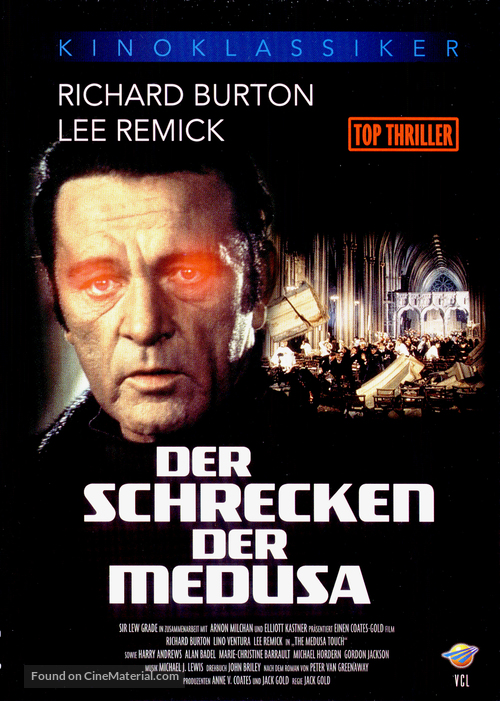
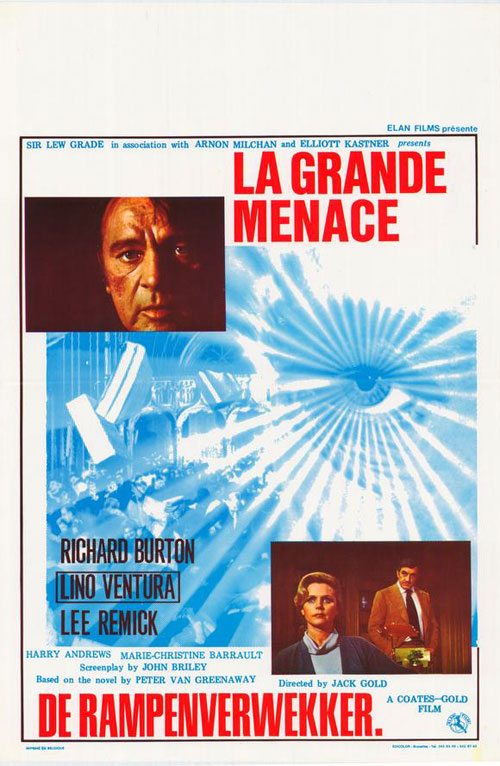


Burton as a defence lawyer (a la Van Greenaway) rants in one barnstorming scene but the film is not Oscar material. In fact, Burton did get a nomination for a Saturn Award by the Academy of Science Fiction, Fantasy and Horror.
As for thinking a chair across a room a doctor played by The Professionals’ Gordon Jackson (1923-1990 bone cancer) suggests it’s impossible but I’ve heard of cases of people who can project their ghostly silhouettes long distances such as kilometres in front of the faces of drivers going one hundred kilometres an hour. Try it when a pilot is trying to land a plane! Are these real projections? Have you seen any? Are they produced by the self by the suggestion of another? Then The Medusa Touch shows real footage of those supposedly with the ‘power’ and Gold and the screenwriter are playing with us again as some of the footage has people appearing to cheat while others have been concocted for the movie as ‘real’ tele-psychics.
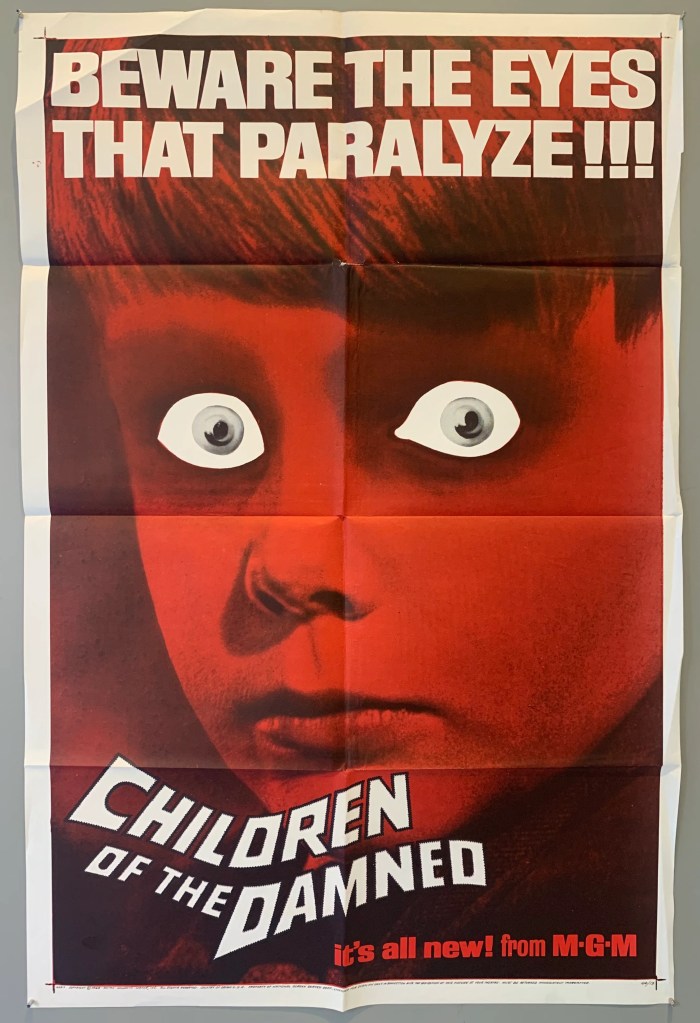
Screenwriter John Briley wrote the effective Children of the Damned (1964) but his work was altered and there is no sign of satirical content in his other work so as a late note I say its his good adaptive work which has done the trick in The Medusa Touch but the meat of it is Van Greenaway. Burton tells his psychiatrist that he’s ‘possessed’ but the novel describes his power as psychokinesis and clairvoyance. The former is the ability to influence physicality without physical touch such as the neighbour jumping from the window or have you felt someone punch you in your sleep but there was no-one there? Then there are the dozen or so spells or witchcraft which include stuffy nose and sleepiness or sleeplessness but we won’t go there.
The film takes the pseudoscience a step further with cars going out of gear and planes crashing which is also psychokinesis.


It could be clairvoyance in terms of picking up another person’s thoughts such as the possibly imagined scene of the tv at the beginning of the movie as clairvoyant thoughts are often carried by the wind or the sound of birds. Today televisions can be hacked and recordings as well as live feed sent through them it should be noted. Your computer too, et cetera…, he said satirically. Clairvoyance could fall into three categories:
(i) straight clairvoyance where the person hears, thinks or maybe speaks another’s thoughts
either shortly after or is unison whether close at hand or at a long distance;
(ii) Intuition where person speaks un unison due to established thought or feeling patterns which
may be a collective memory and this may also happen over a long distance;
(iii) Intuitive clairvoyant (i) where the person speaks the thoughts of another, or the other person
thinks what the other person speaks a microsecond beforehand or what seems like to be the same moment (ii) this could be the meeting of two minds so to speak rhyming as the kids say ‘jinx’ to a lesser degree.
This could be all bullshit too as it has just been suggested it’s just witchcraft and is all hard to categorised anyway without sounding crazy or repetitive..
“It was so… beyond belief,” says Remick about Burton’s powers to kill, who turns out to be a bit of a nut herself.
Meanwhile Burton brags: “I am a man with a power for catastrophe” and its delivered in typical Burton style once again as the movie moves into a finale with a stand-in for Westminster Abbey filmed somewhere in Bristol and the royal family and the prime minister which rings of one of the Quatermass movies of the 1950s in terms of bringing the whole edifice “down on their heads”. The film has a tv movie look with its constructed sets, but the familiar faces from old time British flicks adds a sense of weight while Burton supplies the gravitas. Otherwise without the cast it would probably be a worthless tv movie.
Don’t look for gore or cinematic innovation … But when the mystery is over, you’ll want to hear that metallic noise which is perhaps Burton tuning in to others, or the sound a clairvoyant hears when other clairvoyants don’t want them to hear what they are saying. It’s a kind of interference noise and some may hear it anyway and know not what it means… Is that a Dalek in my head or am I crazy, he told his psychiatrist… And I could be rambling bullshit again! Anyway this sound is made by the monitor attached to Burton’s badly bashed head and brain. Or is it just birds tweeting in the background? What was that? What was that voice? Which voice is that? Who is imitating whose voice? Oh, why do they hate me so and want me to hang myself!? Interference and the mystery of Red Planet and its associated realm are a part of The Medusa Touch.
And that is the moral question a woman as evil as Medusa must ask herself but cannot as her powers are all consuming and her spite and anger so sudden to strike and unable to be reversed … all based on her unfitness to join society and her ugliness, it is her virago which strikes out.


Medusa does not necessarily think, she has been trained to kill either by herself or by the best hatred she has faced in her formative and ensuing years… and neither does the Medusa Touch which she produces think. It is not thinking, it is a feeling of thinking, or a ‘power’ – perhaps wrapped up in the jargon of language and satanic mumbo jumbo if you want to call that thought – and Burton’s writer grows not to think as he also becomes a staring behemoth in terms of his mind with only a motive and this one ‘thought’ is now a subconscious feeling that he must bring forth into ‘catastrophe’. In the end he is pure near-vegetative fury if that is possible…
Burton is a male Medusa, alone on his island, his looks faded except for those eyes, devoid of love and companionship, even incapable of love ever since he was taught to be afraid of the Bible from a very young age with tragic consequences. A malevolent pariah left to his own devices in front of a book or the television.

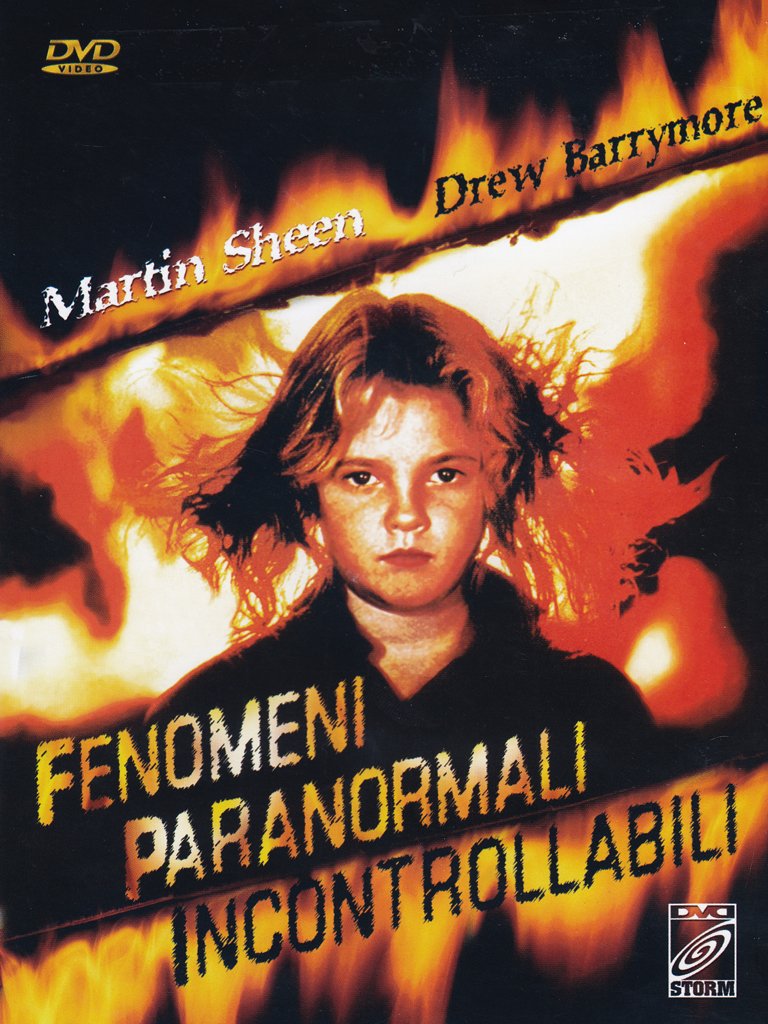


Otherwise watch The Fury (1978) with its explosive ending, the cheap but effective Patrick (1978) and its okay remake from 2018, the wish fulfilment of a bullied schoolgirl in Carrie (1976) and Firestarter both first published by Stephen King years after The Medusa Touch novel. The Firestarter movies were made in 1984 and 2022 with the second one being more than just a mild disappointment being early churned out as Blumhouse fodder too cheap to match its cinematic ambitions. The 1984 version is an epic of sorts starring Drew Barrymore (1975-) and is about pryrokinesis directed by Mark L. Lester (1946-) who made the cult items Roller Boogie (1979) and Class of 1984 (1982) and to quote from that movie: “I’m Elizabeth Taylor!” … Firestarter came after Scanners (1981) which was about all sorts of psychic powers including pyrokinesis… Apparently, King hated the adaptation of his Firestarter novel.
And the Barrymore movie from 1984 has us asking if the news reports that fires aren’t caused by telekinesis then they are probably caused by children playing with matches. The popularity of these movies make them cult fodder but it is the theme of these ‘powers’ which is more of the cult.
Finally, “I am awaiting the report,” says the wish fulfilling Burton again, as if he’s an agent from outer space, sadly spaced out or talking to his approaching killer, near the end of the movie and I have a feeling the scene has been altered to no longer support the theory of the earlier scene and instead it makes the idea of clairvoyance to seem all so silly and the movie perhaps a little more clever in terms of its cod satirical edge. Have you the will to ‘power’?
 Cult Film Alley
Permalink
The Medusa Touch so scared me as a kid. It’s kind of a remake of The Omen in feel, creepiness and Lee Remick (had forgotten she was in this).